

1. Explain the work and its purpose
Begin with the reason you are hiring. Name the work the person will own and the result the team needs. A list of technologies is easier to interpret when it is connected to responsibilities: building APIs for a customer product, maintaining data pipelines or supporting a cloud migration.
Give the role a realistic boundary. Explain the main responsibilities, what already exists and what will change. If the position includes leadership, architecture decisions or production support, say so. Avoid using a broad title to conceal several different jobs; the person reading the brief should be able to picture the work rather than infer it.
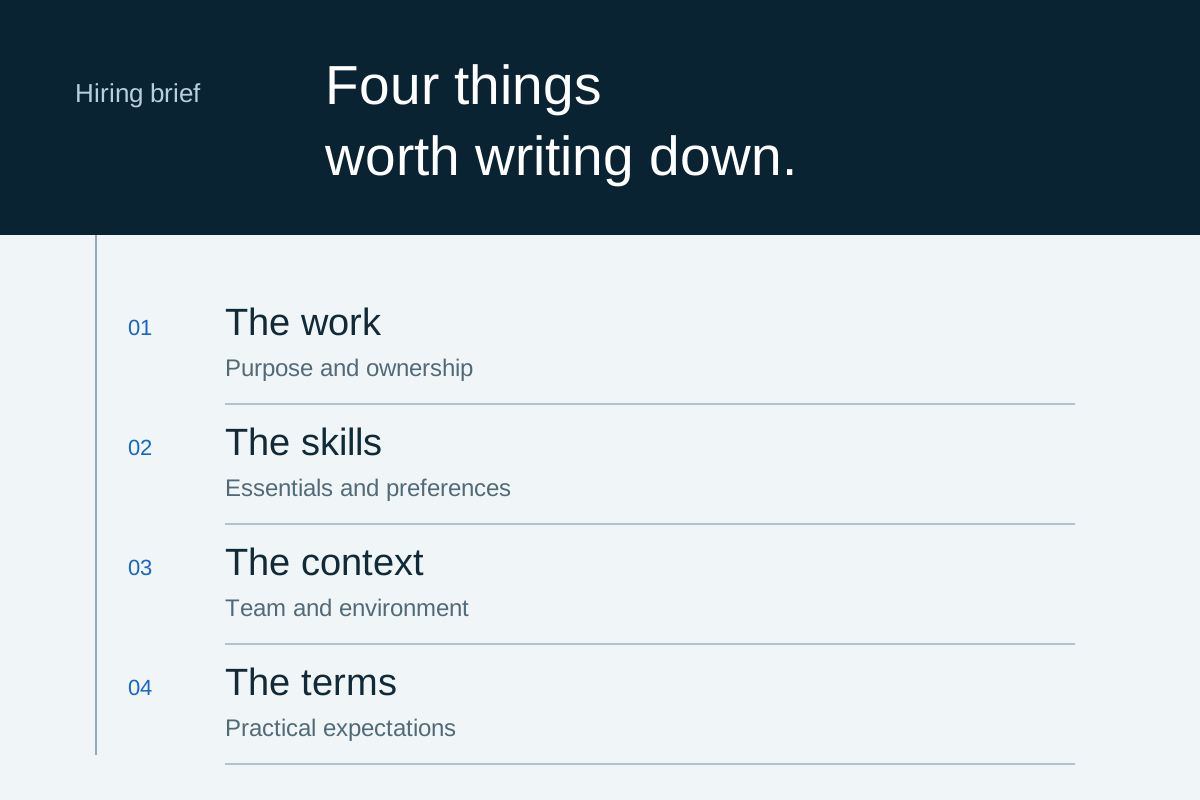
The work
Purpose & ownership
The skills
Essentials & preferences
The context
Team & environment
The terms
Practical expectations
2. Separate essential experience from preferences
An effective brief distinguishes the few requirements that matter on day one from skills that are useful but negotiable. If a particular platform is essential because the team cannot provide training, explain that context. If experience with a similar tool could be relevant, make room for it instead of demanding every item on a long list.
Describe evidence you would like to discuss. For an API role, that might be experience maintaining production services and investigating failures. For data work, it might be designing pipelines and managing quality issues. Specific responsibilities give candidates a better way to explain their experience than a collection of unsupported proficiency labels.
3. Describe the team and environment
People need to understand where their work fits. Describe the team they will join, the reporting relationship and the colleagues they will work with. Name the established systems, relevant constraints and the level of support available. These details help distinguish a role in a mature environment from one that involves creating the foundations.
Be honest about uncertainty. If the architecture is changing or the role is new, explain what is already decided and what the person may help shape. A brief does not need to solve every future question, but it should not make an undefined remit sound settled. Share enough context for a useful first conversation.
worth writing down.
The work
Purpose and ownership
The skills
Essentials and preferences
The context
Team and environment
The terms
Practical expectations
A useful brief in four parts
Explain the work. Separate essential skills. Describe the environment. Make practical terms visible.
4. Make the practical terms visible
Include the hiring model, expected duration where relevant, location, working arrangement and target start date. If the role has a particular time zone requirement, travel expectation or support schedule, state it. Discuss compensation and commercial terms through the appropriate process rather than leaving all practical questions until the end.
Also explain the expected interview steps and who will make the decision, if those details are known. A hiring timeline is more useful when it reflects the availability of the people conducting interviews. Clear practical information helps avoid conversations that discover a basic mismatch only after both sides have invested time.
An example of a clearer starting point
Instead of asking for a “full-stack expert with all modern technologies,” a team could describe a backend engineer who will build and maintain APIs for an existing product. It could identify the current language and database, state that production debugging is essential, and explain that frontend experience is useful but secondary. The difference is context, not extra length.
The brief could then describe the current engineering team, who owns product decisions and whether the engagement is permanent or time-bound. Finally, it could state the working arrangement and the intended interview process. This is an illustrative structure, not a real vacancy or a recommendation to copy requirements that do not match your work.
Give the brief a clear owner in your team. If responsibilities, priorities or essential requirements change, update the same document rather than passing different versions to different people. Agree how feedback from the first candidate conversations will be reviewed. That allows you to refine the requirement deliberately while keeping recruiters, interviewers and candidates working from a consistent description of the role.
Before you send your requirement, read it from the candidate’s perspective. Can someone understand the work, identify the essential experience and judge the practical fit? Remove repeated adjectives and unexplained acronyms. If parts are still open, mark them as questions. A clear outline is enough to begin a hiring conversation and refine the brief together.
Further reading
General guidance, rather than a description of a specific vacancy or a substitute for advice about your circumstances.